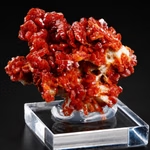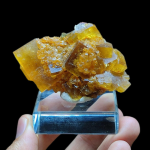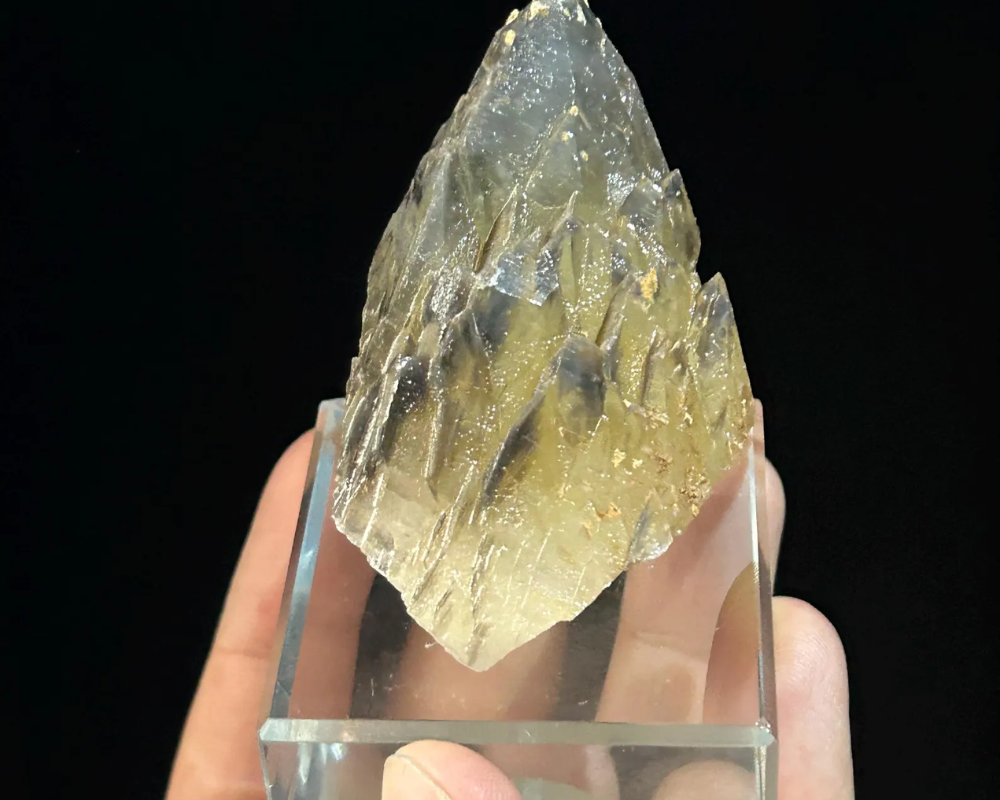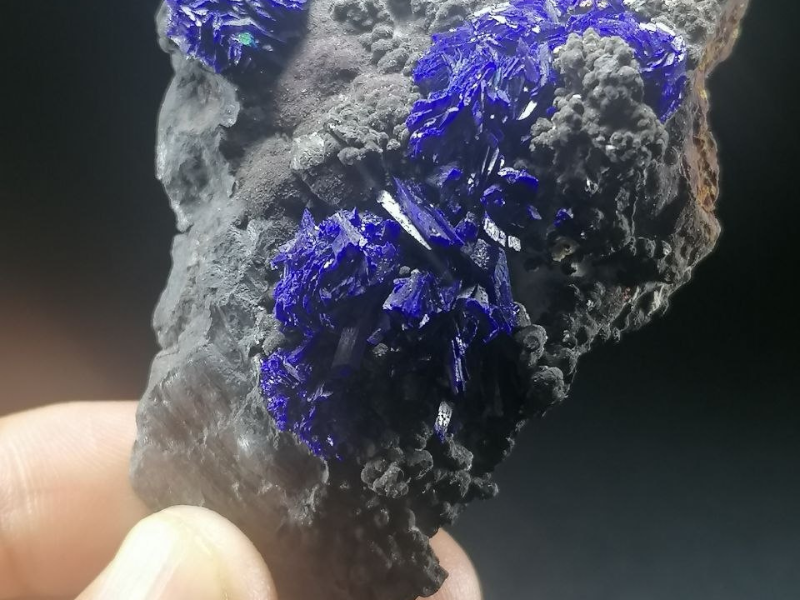

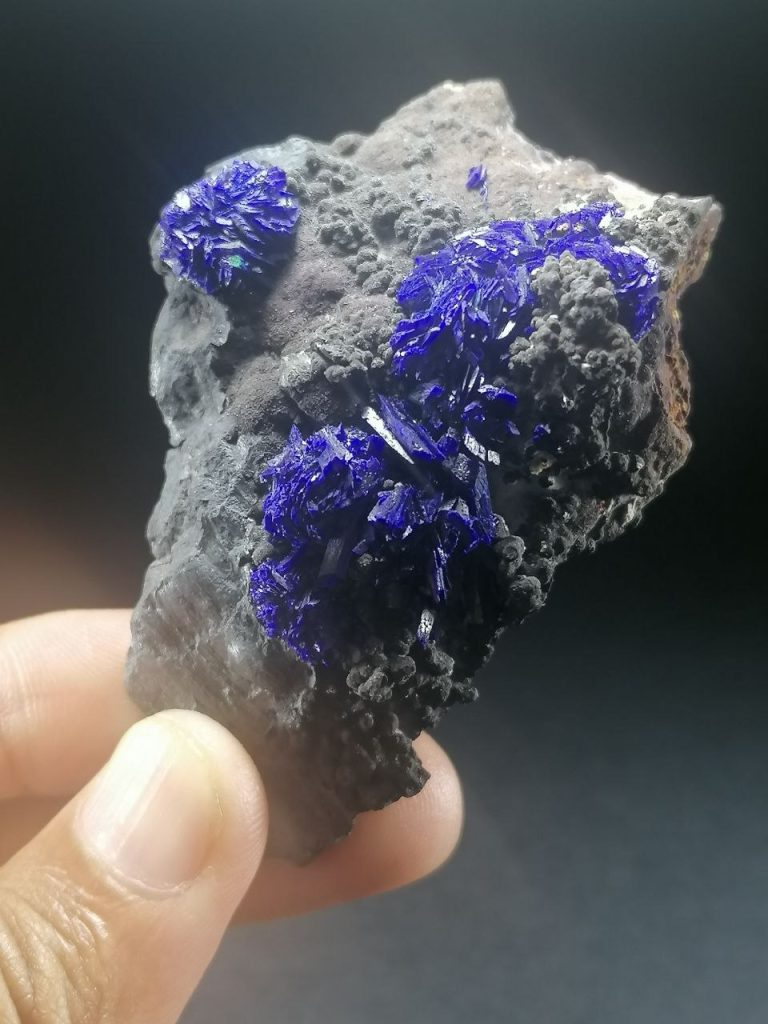
For a preliminary identification, color is usually the easiest characteristic. A strongly blue copper carbonate specimen is likely to be azurite, while a bright green specimen is likely to be malachite. However, mineral identification should never rely exclusively on color.
Azurite commonly displays a deep azure-blue color and vitreous luster, while malachite is characteristically green and often develops botryoidal, mammillary, fibrous, or banded forms. Both have similar Mohs hardness values, so hardness alone is not a particularly useful way to distinguish them.
For scientific identification, mineralogists can use techniques such as X-ray diffraction, Raman spectroscopy, infrared spectroscopy, scanning electron microscopy, and chemical analysis. These methods can establish the mineral’s crystal structure and chemical composition much more reliably than visual inspection.
Why the Azurite-Malachite Relationship Matters in Geology
The relationship between azurite and malachite provides an excellent example of how mineral assemblages respond to changing environmental conditions. Minerals are controlled by chemical equilibria. When groundwater chemistry changes, a mineral that was previously stable may become less stable, while another mineral becomes favored. Changes in pH, carbonate activity, carbon dioxide pressure, oxidation conditions, and dissolved metal concentrations can all influence mineral stability.
Research into azurite and malachite stability has shown that their transition can be particularly sensitive to relatively small changes in chemical conditions. This is one reason the two minerals can occur together or why azurite may be progressively altered to malachite in some geological environments.
This also demonstrates why mineral specimens can be viewed as geological records. A specimen containing azurite, malachite, and pseudomorphic textures may preserve evidence of fluid movement and changing geochemical conditions within an ore deposit.
Azurite and Malachite as Mineral Specimens
Both azurite and malachite have long been valued as mineral specimens and pigments. Their intense colors made them historically important natural coloring materials, particularly before the widespread availability of modern synthetic pigments. Scientific investigations of their thermal behavior have demonstrated that both minerals undergo complex decomposition reactions involving the release of water and carbon dioxide at elevated temperatures.
For mineral collectors, however, their importance goes beyond color. Crystal form, locality, matrix, degree of alteration, luster, surface condition, and mineral associations all contribute to the scientific and aesthetic value of a specimen.
A specimen containing blue azurite with green malachite can be especially interesting because it combines two distinct mineral species within one geological context. If the specimen also preserves pseudomorphic textures, it may provide direct visual evidence of mineral replacement.
F A Q
Is azurite just blue malachite?
No. Azurite and malachite are separate mineral species. Azurite is Cu₃(CO₃)₂(OH)₂, while malachite is Cu₂(CO₃)(OH)₂. They are chemically related but have different compositions and structures.
Which is rarer, azurite or malachite?
Azurite is generally less common than malachite in many oxidized copper deposits. Its stability field is more restricted under many natural conditions, which helps explain why malachite is commonly the more abundant copper carbonate mineral.
Can malachite form from azurite?
Yes. Under suitable geochemical conditions, azurite can be replaced by malachite. This process can produce malachite pseudomorphs after azurite.
Why are azurite and malachite often found together?
They form in related oxidized copper environments and their stability fields can overlap. Changing fluid chemistry can also cause one mineral to replace the other.
Are azurite and malachite the same hardness?
They are very similar in hardness. Both are typically reported at approximately 3.5 to 4 on the Mohs scale.
Two Minerals, One Geological Story
So, are azurite and malachite the same? No, but they are closely related. Both are secondary copper carbonate minerals associated with the oxidized zones of copper deposits, and both contain copper, carbonate, hydroxyl, oxygen, and hydrogen. Yet their chemical formulas are different, their structures are distinct, and their characteristic colors are dramatically different.
Azurite is recognized by its deep azure-blue color and commonly vitreous luster, while malachite is distinguished by its vivid green color and frequently botryoidal, fibrous, mammillary, or banded appearance. Both have a Mohs hardness of approximately 3.5 to 4, but their specific gravities and mineral habits also provide useful identification clues.
Perhaps the most interesting part of their relationship is that they are not simply two unrelated minerals that happen to occur in the same rocks. Their chemistry and stability are closely connected. Under changing geological conditions, azurite can be altered to malachite, sometimes producing pseudomorphs that preserve the external form of the original azurite crystal. This makes the azurite-malachite relationship an excellent example of how mineral chemistry, crystallography, groundwater, and geological processes interact over time.
For anyone interested in azurite, malachite, copper minerals, mineral identification, Moroccan minerals, or mineralogy, understanding this relationship provides a deeper appreciation of what a mineral specimen actually represents. A blue crystal beside a green one is not merely a beautiful color combination. It can be a record of chemical reactions, changing fluids, mineral stability, and the geological history of an ore deposit.