
Unique Calcite Crystal from Imilchil, Morocco: A Natural Mineral Specimen from the High Atlas
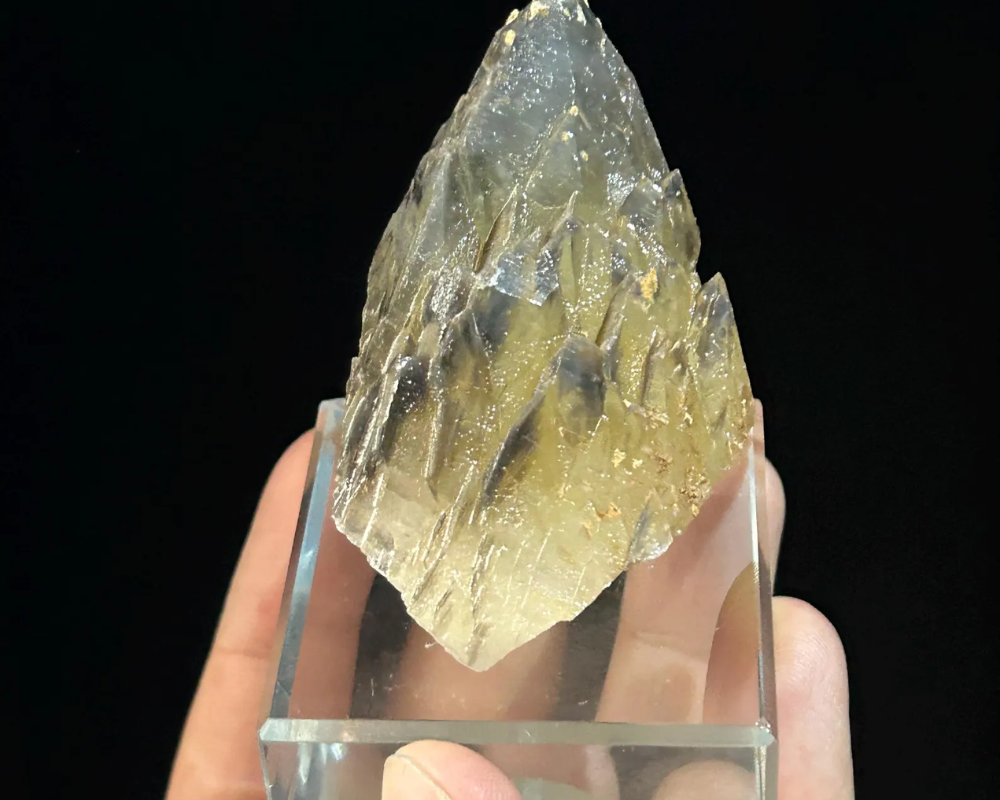
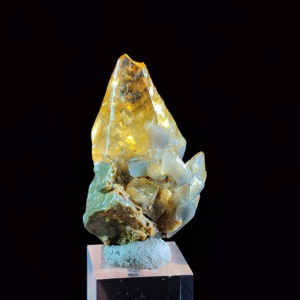
There is something special about a natural mineral specimen that makes it different from an ordinary decorative object. A crystal is not manufactured to look beautiful. Its shape, surfaces, transparency, color, inclusions, and imperfections are the result of geological processes that took place long before the specimen was collected. This natural Calcite crystal from Imilchil, Midelt, Morocco is a beautiful example of that natural character, combining a distinctive crystal form with translucent areas, warm golden tones, and contrasting matrix.
For mineral collectors, specimens from Morocco are particularly interesting because the country is internationally recognized for its diverse mineral localities and remarkable crystal specimens. The Imilchil area, in the wider Midelt Province of central Morocco, is associated with a range of minerals, including calcite, and specimens sold under the name “Imilchil” can represent material originating from several localities in the surrounding area.
This specimen measures approximately 5 × 3 × 3 cm and weighs 35 g, making it a compact piece that can be displayed easily in a mineral cabinet, geology collection, office, study, or home. The display stand shown in the photograph is not included.
A Distinctive Natural Calcite Crystal from Morocco
The first thing that stands out about this specimen is its unusual natural form. Rather than being a perfectly uniform geometric object, the crystal displays variations in transparency, surface development, color, and associated material. These characteristics are part of what makes natural mineral specimens attractive to collectors.
The main crystal has warm yellow to golden tones, with translucent and more transparent areas that allow light to interact with the interior of the specimen. Around the principal crystal are additional crystalline features and matrix material, creating a more complex three-dimensional composition. The combination of the larger central crystal and smaller associated formations gives the specimen a natural, geological appearance rather than the uniform appearance of a manufactured decorative crystal.
The dark background in the photograph also emphasizes the optical character of the specimen. Light passing through the translucent portions produces subtle variations in color and brightness, while the more opaque areas reveal the natural texture and mineral matrix.
For a collector, these details are important because the appeal of a specimen is not determined only by its size. Crystal form, luster, transparency, associations, locality, condition, and overall aesthetics all contribute to its value as a geological specimen.
What Is Calcite?
Calcite is one of the most important and widespread carbonate minerals on Earth. Its chemical formula is CaCO₃, meaning it consists ideally of calcium, carbon, and oxygen. It belongs to the calcite group and crystallizes in the trigonal crystal system. Calcite has a Mohs hardness of approximately 3 and a specific gravity of about 2.71.
Although calcite is chemically simple, it can develop an extraordinary range of crystal forms and colors. It may occur as colorless or white crystals, but natural calcite can also appear yellow, orange, red, brown, blue, green, gray, and other shades depending on its formation environment and the presence of impurities or inclusions.
The diversity of calcite is one reason it remains such an important mineral for both professional mineralogists and collectors. Two calcite specimens can have exactly the same basic chemical formula while looking dramatically different because their crystal habits, growth conditions, impurities, inclusions, and associated minerals are different.
The Science Behind the Crystal
The chemical formula CaCO₃ describes the ideal composition of calcite. At the atomic level, calcium ions and carbonate groups are arranged in an ordered crystal structure. The arrangement of these atoms is responsible for many of the physical properties that mineral collectors can observe.
Calcite belongs to the trigonal crystal system, although its crystals are often described visually using forms that may appear strongly hexagonal. Common calcite crystal habits include rhombohedra, scalenohedra, tabular forms, and combinations of several crystal faces. Twinning is also common in calcite, contributing to some of the unusual crystal shapes encountered in natural specimens.
One of the most characteristic properties of calcite is its perfect rhombohedral cleavage. When calcite breaks along its cleavage planes, it can produce surfaces that intersect at angles characteristic of its crystal structure. This is one of the useful properties mineralogists use when identifying calcite.
Calcite is also relatively soft compared with many common minerals. With a Mohs hardness of about 3, it can be scratched by harder materials and should therefore be handled carefully. Its relatively low hardness is one of the reasons collectors should avoid rubbing calcite specimens against other minerals during storage or transportation.
Why Calcite Can Be Transparent or Translucent
The appearance of this Imilchil calcite is partly related to the way light interacts with its crystalline structure.
A transparent crystal allows significant light to pass through it, while a translucent crystal permits light through but scatters or absorbs enough of it that objects cannot be seen clearly through the material. Calcite can occur in transparent, translucent, or opaque forms.
The specimen shown here contains areas that appear translucent to more transparent, particularly within the larger golden crystal. These optical variations make the specimen more visually interesting because its appearance changes according to the direction and intensity of the light.
Clear calcite is also scientifically famous for its strong optical properties. Calcite is uniaxial negative and has significant birefringence. In suitable transparent pieces, this optical behavior can produce the well-known double-image effect associated with clear calcite.
The phenomenon occurs because light travels through the anisotropic crystal structure at different velocities depending on its polarization and direction of travel. This makes calcite an important mineral not only for collectors but also in the study of mineral optics.
The Golden Color of This Moroccan Calcite
Color is one of the most attractive features of this specimen. The crystal displays warm yellow, honey, and golden tones, with darker areas and translucent zones adding contrast.
It is important, however, not to assume that the yellow color of a calcite specimen automatically indicates one specific impurity. Calcite can contain minor substitutions and trace elements, and its color can be influenced by various geological factors. Documented calcite chemistry can include substitutions involving elements such as magnesium, iron, manganese, zinc, cobalt, barium, strontium, lead, copper, and others.
For this particular specimen, the photograph alone cannot establish which trace elements or microscopic inclusions are responsible for its exact coloration. A laboratory chemical analysis would be required to determine its detailed composition.
That distinction is important for serious mineral collecting. Visual appearance can provide valuable clues, but scientific identification of trace elements requires analytical methods such as X-ray diffraction, electron microscopy, spectroscopy, or chemical analysis.
Calcite in the Imilchil Area of Morocco
The name Imilchil is strongly associated with mineral specimens from the surrounding High Atlas region of Morocco. However, locality terminology deserves some clarification.
Imilchil itself is a town and commune in Midelt Province. Mineral databases distinguish the town from the broader Imilchil area, which includes mineral-producing localities in the surrounding region. Mindat specifically notes that specimens labeled simply as “Imilchil” may originate from several localities around the area rather than from the town itself.
Calcite is documented from the wider Imilchil area, including localities such as Takat, Bou Azmou, where calcite occurs alongside minerals such as chabazite-Ca, prehnite, and stilbite-Ca.
This broader geological context is important when discussing Moroccan mineral specimens. The locality name can represent a recognized regional collecting area rather than a precise mine or individual outcrop. For collectors who require exact locality information, additional provenance from the original collector, dealer, mine, or field locality can provide more precise documentation.
For this specimen, the stated origin is Imilchil, Midelt, Morocco.
A Connection to the Rich Mineralogy of Midelt
Midelt Province is one of Morocco’s most important mineral regions for collectors. The province contains numerous mineral localities and mining districts, each with its own geological characteristics.
The wider region is particularly famous for lead, vanadium, phosphate, carbonate, and silicate minerals. Mibladen, for example, is internationally known for exceptional vanadinite, while the broader Midelt region contains many other mineral occurrences.
The Imilchil area adds another dimension to this mineralogical diversity. Calcite is documented there, along with minerals such as andradite, grossular, quartz, fluorapatite, and several zeolite-related species depending on the specific locality.
This diversity makes Moroccan specimens interesting to collectors who want to build locality-based collections. A specimen is not simply a piece of mineral matter. It can also represent a particular geological region and contribute to the story of mineral formation in that area.
How This Specimen Can Be Displayed
With dimensions of approximately 5 × 3 × 3 cm, this is a compact specimen that does not require a large display cabinet.
Its relatively small footprint makes it suitable for a mineral shelf, glass display case, desk, study, geological collection, or private mineral cabinet. The golden color can also make it visually attractive when displayed against a dark or neutral background.
Because calcite has a Mohs hardness of only about 3 and has perfect cleavage, it should be positioned somewhere it will not be frequently touched or knocked against harder objects.
The specimen can be displayed on a suitable mineral stand, although the display stand shown in the photograph is not included.
For collectors, a good display position should show the main crystal from its strongest viewing angle while allowing light to reach the translucent portions. Natural daylight or soft directional lighting can reveal differences between transparent, translucent, and opaque parts of the specimen.
Why Collectors Appreciate Natural Moroccan Minerals
Moroccan minerals have developed a strong reputation among collectors because of the extraordinary variety of mineral localities found throughout the country. Specimens from different Moroccan regions can display very different crystal habits, colors, mineral associations, and geological histories.
A natural Moroccan calcite specimen therefore offers more than decorative appeal. It can be a small physical representation of geological processes involving carbonate-rich fluids, temperature, pressure, rock chemistry, and crystal growth.
The individuality of natural specimens is another important aspect of collecting. Even when two crystals come from the same general locality, they may differ significantly in shape and appearance because crystal growth is influenced by the local environment at the time of formation.
That means a specimen such as this one is naturally individual. Its exact arrangement of crystals, matrix, surfaces, inclusions, and color is not something that can be perfectly reproduced.
Calcite for Mineral Collectors and Geology Enthusiasts
Calcite is an excellent mineral for collectors who are interested in learning mineralogy because it demonstrates several important geological and physical concepts in a single species.
Its chemical formula is simple: CaCO₃. Its crystal system is trigonal. Its hardness is approximately 3. It has perfect cleavage, variable transparency, a wide range of possible colors, and distinctive optical properties.
These characteristics make calcite useful for teaching and studying crystal chemistry, crystallography, mineral identification, optical mineralogy, and geology.
For beginners, calcite is also an excellent mineral to compare with other carbonate minerals. Its relatively low hardness, rhombohedral cleavage, and reaction with weak acids are among the properties that can help distinguish it from some visually similar minerals.
For experienced collectors, locality and crystal quality become increasingly important. A well-formed crystal with attractive transparency, unusual habit, strong luster, or interesting mineral associations can be a valuable addition to a specialized collection.
Specimen Details
Mineral: Natural Calcite
Chemical Formula: CaCO₃
Origin: Imilchil, Midelt, Morocco
Specimen Size: 5 × 3 × 3 cm
Weight: 35 g
Crystal Character: Natural, distinctive crystal formation
Color: Golden to yellow with translucent areas and natural matrix
Display Stand: Not included
Shipping: Free worldwide shipping
The dimensions and weight above describe the individual specimen offered. As with natural minerals, small variations in surface texture, color distribution, inclusions, and crystal features are part of the specimen’s natural character.
A Small Specimen with a Geological Story
What makes this Calcite crystal from Imilchil, Morocco particularly appealing is the combination of compact size and distinctive natural form. At approximately 5 cm, it is small enough for easy display while still offering enough crystal development to study its form and internal appearance.
The warm golden color, translucent sections, natural matrix, and irregular crystal growth give it a character that is difficult to reproduce artificially. For someone beginning a Moroccan mineral collection, it can serve as an accessible example of calcite from the Imilchil area. For an established collector, it can add another locality and another expression of calcium carbonate to a broader mineral collection.
Most importantly, it is a natural geological object. Its surfaces and imperfections are part of its identity, recording the conditions under which the crystal developed.
A natural Calcite crystal from Imilchil, Midelt, Morocco is more than an attractive crystal. It represents the intersection of mineral chemistry, crystallography, geology, and Moroccan mineral heritage.
With the chemical formula CaCO₃, trigonal crystal structure, Mohs hardness of approximately 3, and distinctive optical and cleavage properties, calcite is one of the fundamental minerals of mineralogy. The Imilchil area adds an important geographical dimension, connecting the specimen to the mineral-rich landscapes of Midelt Province and the High Atlas region.
For collectors, geology enthusiasts, educators, or anyone who appreciates natural mineral specimens, this compact Moroccan calcite offers a combination of scientific interest and visual character. Its golden tones, translucent crystal areas, natural matrix, and distinctive formation make it a unique addition to a collection or mineral display.
This specimen is offered as a natural Calcite crystal from the Imilchil area of Midelt, Morocco, measuring approximately 5 × 3 × 3 cm and weighing 35 g. Free worldwide shipping is included.