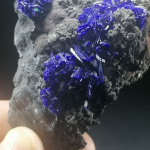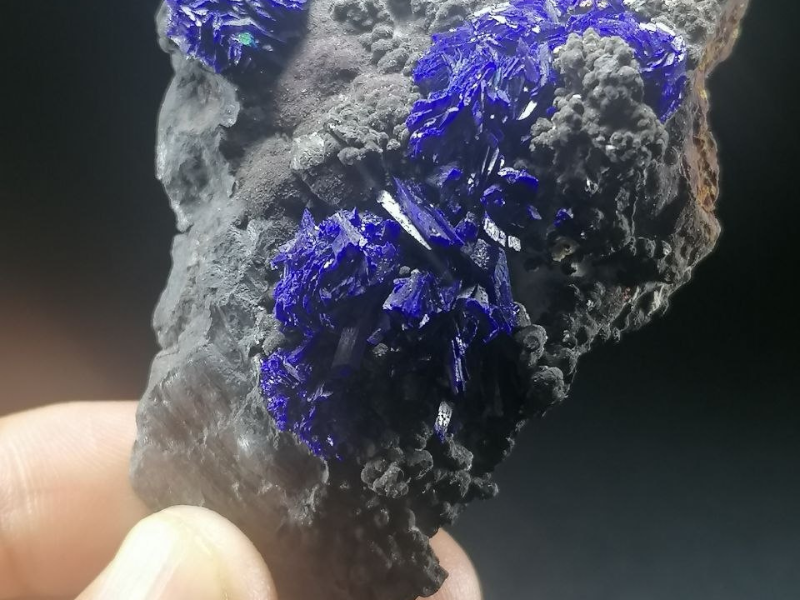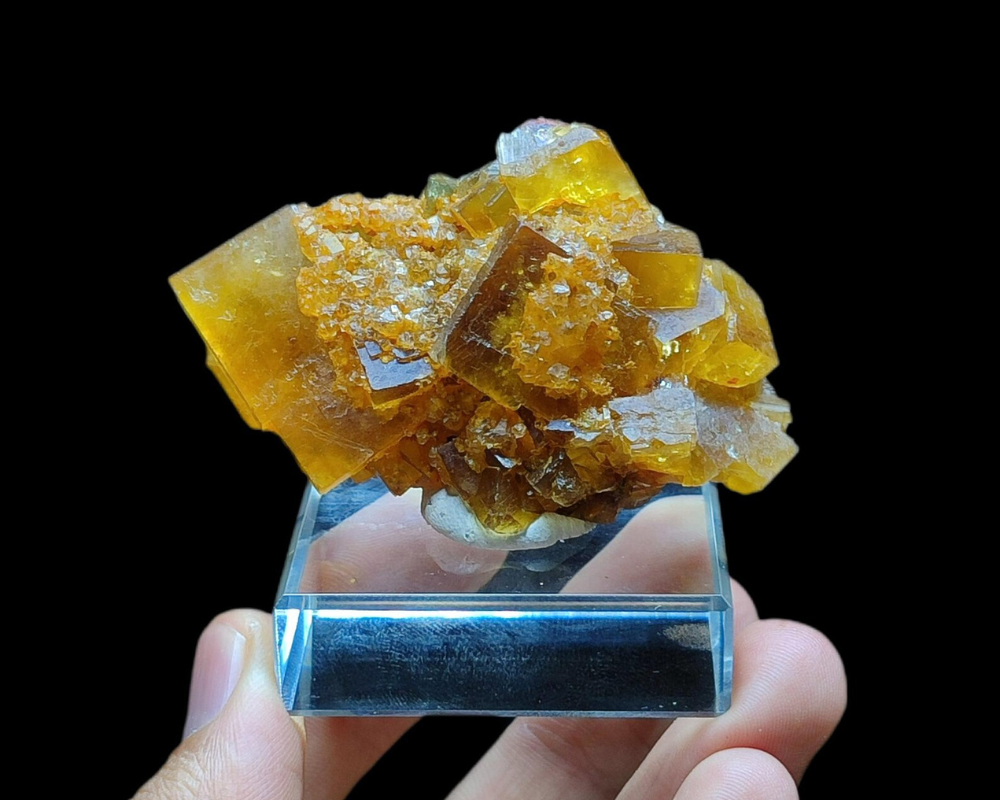

Discover calcite, one of Earth’s most common minerals, including calcite crystals, colors, properties, crystal forms, formation, and popular varieties such as orange calcite, blue calcite, honey calcite, green calcite, and Caribbean calcite.
What Is Calcite?
Calcite is one of the most common and scientifically important minerals on Earth. It is a calcium carbonate mineral with the chemical formula CaCO3.
Calcite belongs to the carbonate mineral group and crystallizes in the trigonal crystal system. It occurs in a remarkable variety of geological environments, including sedimentary rocks, metamorphic rocks, hydrothermal veins, cavities, and many other mineral-forming settings.
One of the most important characteristics of calcite is its relatively low hardness. Calcite has a Mohs hardness of 3, which means that it can be scratched more easily than many common minerals.
Calcite is also known for its excellent rhombohedral cleavage. When broken or cleaved along its natural cleavage directions, calcite can produce characteristic rhombohedral fragments.
For mineral collectors, calcite is especially interesting because it can develop an extraordinary variety of crystal forms, colors, associations, and habits. A single mineral species can therefore produce specimens with dramatically different appearances.
Calcite Mineral Properties
Understanding the physical and chemical properties of calcite is essential for mineral identification and collecting. The following characteristics are among the most useful when examining a calcite specimen.
| Property | Calcite |
|---|---|
| Mineral Name | Calcite |
| Chemical Formula | CaCO3 |
| Mineral Class | Carbonate |
| Crystal System | Trigonal |
| Mohs Hardness | 3 |
| Specific Gravity | Approximately 2.71 |
| Streak | White |
| Cleavage | Perfect rhombohedral cleavage |
| Luster | Vitreous to pearly depending on surface and form |
| Transparency | Transparent to translucent |
| Common Colors | Colorless, white, yellow, orange, blue, green, brown, gray and others |
| Common Crystal Habits | Rhombohedral, scalenohedral, prismatic, massive and other forms |
Calcite Crystal Shapes and Habits
One of the most fascinating characteristics of calcite is its extraordinary variety of crystal forms. Collectors can encounter calcite as simple rhombohedra, elongated scalenohedra, complex combinations of crystal faces, aggregates, coatings, and unusual twins.
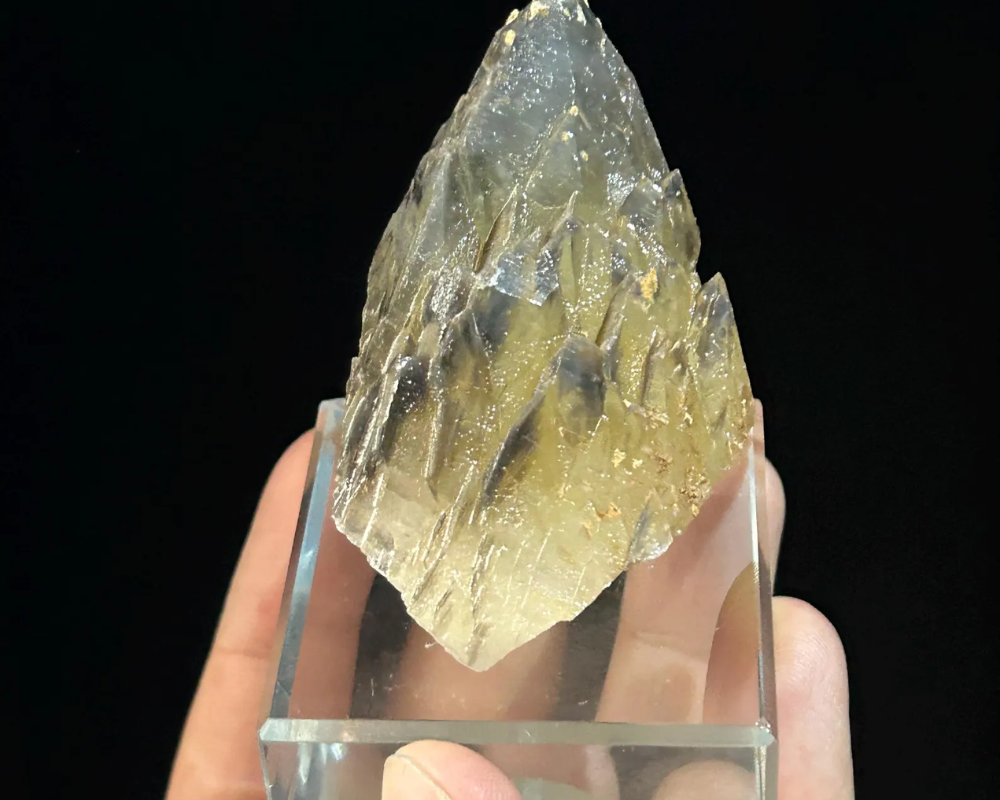
Rhombohedral Calcite
Rhombohedral calcite is among the most recognizable forms of the mineral. The crystals have a characteristic geometry associated with calcite’s crystal structure and cleavage.
Transparent rhombohedral calcite crystals can be particularly attractive because their clarity may allow collectors to observe the mineral’s optical properties.
Scalenohedral Calcite
Scalenohedral calcite can develop elongated, pointed crystals with a distinctive appearance. When these crystals form attractive groups, they can become highly desirable collector specimens.
The classic pointed form is commonly associated with what mineral collectors call dogtooth calcite.
Prismatic Calcite
Calcite can also form prismatic crystals and combinations of several crystal forms. The exact appearance depends on the conditions under which the mineral crystallized.
Twinned Calcite Crystals
Twinning is another important feature of calcite mineralogy. Some calcite crystals develop unusual twin structures that can produce distinctive shapes.
Among the best-known examples are butterfly twins, which are particularly interesting to mineral collectors and students of crystallography.
Why Does Calcite Have Different Colors?
Pure calcite is commonly colorless or white, but natural calcite can occur in a remarkably broad range of colors.
The appearance of calcite can be influenced by trace elements, impurities, inclusions, structural defects, and other geological factors. As a result, specimens of the same mineral species can display very different colors.
Depending on the specimen, calcite may appear white, colorless, yellow, orange, blue, green, brown, gray, or in other shades.
Color is an important visual characteristic, but it should not be used by itself to identify calcite. Proper mineral identification should consider several physical and mineralogical properties together.
Orange Calcite
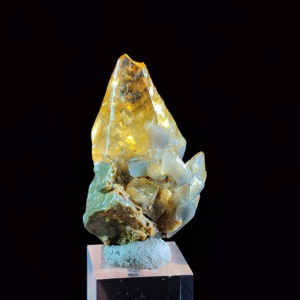
Orange calcite is one of the most visually appealing color varieties encountered by mineral collectors. Its color can range from pale orange to deeper warm orange tones.
The exact color of an orange calcite specimen depends on its individual geological history and the factors responsible for the coloration.
Orange calcite is popular in both mineral collections and decorative displays. Particularly attractive specimens may combine a strong orange color with good crystal development, natural luster, transparency, or an interesting matrix.
When evaluating an orange calcite specimen, collectors should consider more than color alone. Crystal form, condition, locality, transparency, luster, and overall aesthetics can all influence the appeal of the specimen.
Blue Calcite
Blue calcite is another attractive form of calcite appreciated for its soft blue to blue-gray appearance.
The intensity and character of the blue color can vary considerably between specimens. Some examples display delicate pale blue tones, while others have stronger blue-gray coloration.
For collectors, blue calcite can be particularly attractive when its color is combined with interesting crystal shapes, natural matrix, or good surface quality.
As with other calcite varieties, the locality and mineralogical characteristics of an individual specimen are important when documenting its identity and origin.
Honey Calcite
Honey calcite is a term commonly used by mineral collectors and sellers for attractive yellow to honey-colored calcite material.
The warm coloration can give honey calcite a distinctive appearance, particularly when the crystals have good transparency or luster.
Well-developed honey-colored calcite crystals can be excellent display specimens. As with other varieties, collectors should consider the complete specimen rather than focusing only on color.
Green Calcite
Green calcite occurs in shades ranging from pale green to stronger green tones.
The green appearance may be associated with impurities, inclusions, or other factors affecting the mineral during its formation.
Because several geological processes can influence mineral coloration, locality information is particularly useful when evaluating a colored calcite specimen.
Caribbean Calcite
Caribbean calcite is a trade name used for an attractive blue and white calcite material that has become popular in the mineral and decorative stone market.
Its characteristic combination of blue and pale colors gives it a distinctive visual appearance compared with many classic calcite specimens.
Collectors should remember that trade names are not necessarily formal mineral species classifications. The underlying mineral is calcite when its chemical composition and crystal structure correspond to calcite.
How Does Calcite Form?
Calcite can form through many different geological processes. It is one of the most widespread minerals in Earth’s crust and occurs in sedimentary, metamorphic, and hydrothermal environments.
One important mechanism involves water containing dissolved calcium and carbonate. When the chemical conditions change, calcium carbonate can precipitate and crystallize as calcite.
Calcite can also develop inside cavities and fractures where mineral-rich fluids circulate through rocks. If sufficient space is available, crystals may grow with well-developed faces.
The final appearance of a calcite specimen depends on numerous factors, including temperature, pressure, fluid chemistry, available space, host rock, impurities, and the rate of crystal growth.
This is one reason why calcite specimens from different localities can look dramatically different even though they are all composed of the same mineral species.
Calcite in Limestone and Marble
Calcite is one of the principal minerals found in limestone, an important sedimentary rock composed largely of calcium carbonate.
Limestone can form through several processes, including the accumulation and lithification of carbonate-rich sediments.
When limestone undergoes metamorphism, its calcite grains can recrystallize and produce marble.
This makes calcite important not only to mineral collectors but also to geology, sedimentology, metamorphic petrology, construction materials, and the broader study of Earth’s crust.
Calcite and Acid Reaction
One of the classic characteristics used in mineral identification is the reaction of calcite with dilute acid.
Because calcite is calcium carbonate, it can react with dilute hydrochloric acid and produce visible effervescence as carbon dioxide is released.
This reaction has traditionally been used by geologists and mineralogists as a practical way of recognizing carbonate minerals.
However, valuable or delicate mineral specimens should not be subjected to acid testing unnecessarily because chemical testing can affect the surface of the specimen.
Calcite and Double Refraction
Transparent calcite provides one of the most famous demonstrations of an optical phenomenon known as double refraction, or birefringence.
When a transparent calcite crystal is placed over printed text, the letters may appear doubled when viewed through the crystal.
This occurs because light travels through calcite in different ways depending on its direction within the crystal.
The optical properties of calcite are an important part of its scientific significance and have made the mineral a classic example in mineralogy and optical science.
Why Is Calcite Important to Mineral Collectors?
Calcite is sometimes overlooked because it is a common mineral. However, abundance does not mean that calcite lacks collecting interest.
The extraordinary diversity of calcite crystal forms means that two specimens can look completely different while both being calcite.
Mineral collectors may seek calcite specimens because of their:
- Exceptional crystal form
- Sharp crystal faces
- Unusual twinning
- Transparency
- Strong luster
- Attractive natural colors
- Interesting mineral associations
- Large crystal size
- Distinctive crystal habits
- Fluorescence in some specimens
- Important geological localities
- Natural matrix and overall aesthetics
A well-formed calcite specimen can therefore be an important addition to a collection even when the mineral itself is widespread.
Natural Calcite vs. Commercial Material
When purchasing calcite, it is important to understand what type of material is being offered.
A natural mineral specimen should retain characteristics resulting from its geological formation and extraction. For collectors, information about the locality and condition of a specimen can be as important as its visual appearance.
When evaluating a natural calcite specimen, consider:
- Locality: Where was the specimen collected?
- Crystal quality: Are the crystal faces well developed?
- Natural matrix: Is the host rock preserved?
- Transparency: Are the crystals transparent, translucent, or opaque?
- Luster: Does the specimen have a strong natural luster?
- Crystal habit: What form do the crystals display?
- Condition: Are there chips, breaks, or damaged areas?
- Dimensions: How large is the actual specimen?
- Photography: Are photographs showing the actual specimen?
For serious collectors, reliable locality information is especially valuable because the geological origin is an important part of a mineral specimen’s identity.
How to Care for Calcite Crystals
Calcite has a Mohs hardness of only 3, so it should be handled carefully.
Its excellent cleavage also means that a strong impact can cause the specimen to break along a cleavage plane.
- Handle calcite specimens carefully.
- Avoid dropping the specimen.
- Keep calcite away from harder minerals that could scratch its surface.
- Do not stack specimens directly on top of one another.
- Protect delicate crystal points.
- Avoid aggressive cleaning methods.
- Use suitable protective packaging when transporting specimens.
- Display valuable specimens in a stable location.
Calcite in Morocco
Morocco is well known among mineral collectors for its geological diversity and for the wide range of mineral specimens produced from different regions of the country.
Calcite is also encountered in Moroccan geological environments and may occur alongside other minerals depending on the locality and geological setting.
For collectors interested in Moroccan minerals, locality information is an essential part of documenting a specimen. The same mineral species can have very different appearances depending on where it formed.
A properly documented Moroccan calcite specimen therefore represents more than the mineral itself. It also records a particular geological environment and the natural conditions that allowed the crystals to develop.
How to Identify Calcite
Several physical and mineralogical characteristics can help identify calcite.
1. Hardness
Calcite has a Mohs hardness of approximately 3, making it relatively soft compared with many common minerals.
2. Cleavage
Calcite has excellent rhombohedral cleavage, which is one of its most useful physical characteristics.
3. Acid Reaction
Calcite reacts readily with dilute hydrochloric acid, producing visible effervescence under appropriate testing conditions.
4. Crystal Form
Rhombohedral and scalenohedral crystal forms are especially characteristic of calcite, although the mineral can develop many other forms.
5. Optical Properties
Transparent calcite can display strong birefringence and the famous double-refraction effect.
No single characteristic should always be relied upon when identifying an unknown mineral. A reliable identification may require several physical tests and, when necessary, laboratory analysis.
FAQ
What is calcite made of?
Calcite is calcium carbonate with the chemical formula CaCO3.
What is the hardness of calcite?
Calcite has a Mohs hardness of approximately 3.
What color is calcite?
Calcite can be colorless, white, yellow, orange, blue, green, brown, gray, and other colors depending on the specimen and the factors responsible for its coloration.
What is a calcite crystal?
A calcite crystal is a naturally formed crystalline expression of the mineral calcite. Calcite can develop several crystal habits, including rhombohedral and scalenohedral forms.
What is orange calcite?
Orange calcite is calcite displaying an orange coloration. It is popular among mineral collectors because of its warm natural color and attractive appearance.
What is blue calcite?
Blue calcite is a blue-colored form of calcite that can range from pale blue to stronger blue-gray tones.
What is honey calcite?
Honey calcite is a collecting and trade term commonly used for yellow to honey-colored calcite material.
What is green calcite?
Green calcite is calcite displaying green coloration, which can range from pale green to stronger shades depending on the specimen.
What is Caribbean calcite?
Caribbean calcite is a trade name used for an attractive blue and white calcite material popular in the mineral and decorative stone market.
Is calcite a valuable mineral?
Calcite is a common mineral, so value is not determined simply by rarity. Collector value can depend on crystal quality, size, color, transparency, locality, condition, aesthetics, and overall specimen quality.
Can calcite be scratched easily?
Yes. With a Mohs hardness of 3, calcite is relatively soft and can be scratched by harder materials.
Does calcite react with acid?
Yes. Calcite, being calcium carbonate, reacts with dilute hydrochloric acid and can produce visible effervescence.
—————————–
Calcite is far more than a common white mineral. Its chemistry, crystal structure, optical properties, cleavage, twinning, colors, and extraordinary variety of crystal habits make it one of the most interesting minerals for both beginners and experienced collectors.
From transparent calcite crystals and classic rhombohedra to orange calcite, blue calcite, honey calcite, green calcite, and unusual twinned specimens, calcite demonstrates how dramatically a single mineral species can appear in nature.
For anyone beginning a mineral collection, calcite is an excellent mineral to study because it provides an introduction to crystal systems, cleavage, hardness, optical properties, mineral formation, and geological associations.
For experienced collectors, exceptional calcite crystals can remain highly desirable because of their aesthetics, locality, crystal form, transparency, associations, and scientific interest.
Calcite is common, but exceptional calcite is anything but ordinary.