
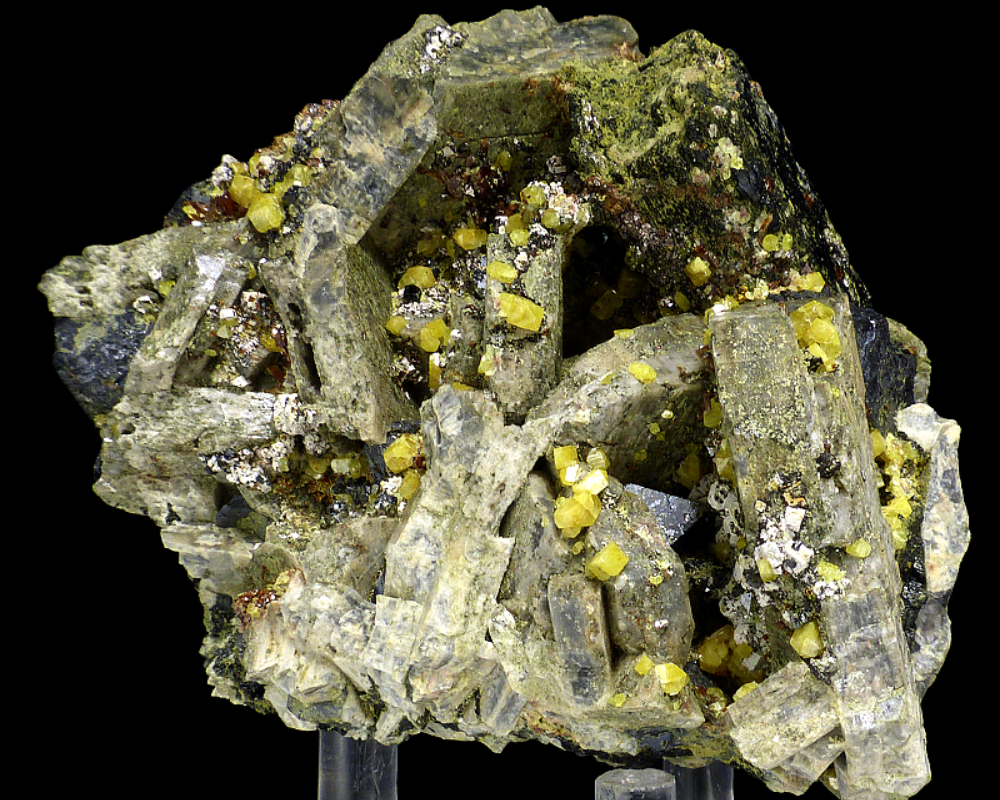
The region is dominated by Mesozoic sedimentary rocks, mainly Jurassic and Cretaceous in age, together with numerous small syenitic intrusions. These intrusions are associated with pegmatites, metasomatic zones and contact metamorphic rocks that have produced a wide variety of collectible minerals.
Among the species reported from the High Atlas are apatite, titanite, prehnite, magnetite, garnet, pyroxene and amphibole. However, the discovery of small pockets containing bright yellow zircon crystals and brown fluorcalciopyrochlore added another fascinating chapter to the mineralogy of this Moroccan locality.
Tizi n’Inouazane: A Classic High Atlas Mineral Locality
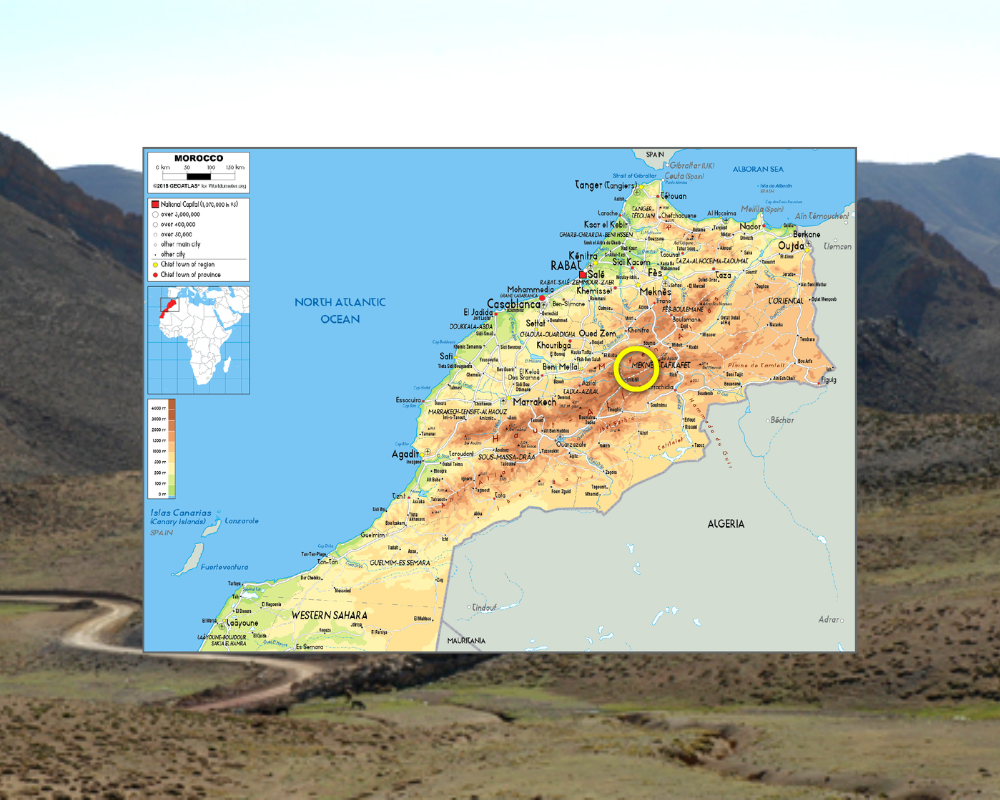
Tizi n’Inouazane, also written as Tizi-n-Inouzane, is a mountain pass located approximately 30 kilometers from Imilchil in the central High Atlas of Morocco. Besides its spectacular mountain scenery, the locality is well known among mineral enthusiasts for its pegmatitic and metasomatic mineralization. For decades, collectors and mineral hunters have explored the area in search of well-formed crystals, particularly the attractive yellow to green apatites for which the region is famous.
Mineralization at Tizi n’Inouazane tends to occur in relatively small zones and pockets. Such occurrences can be highly localized, making successful collecting dependent on finding the right geological structures.
One particularly interesting pocket was discovered in the central part of the pass in 2022. The pocket contained a distinctive association of aegirine, microcline, magnetite, andradite, titanite, zircon, chamosite and fluorcalciopyrochlore. The discovery was especially significant because collectible-quality pyrochlore specimens had not previously been widely described from Morocco.
Aegirine: The Dark Matrix for Bright Yellow Zircons
Aegirine is one of the most visually important minerals from this pocket. The crystals range from dark green to almost black and commonly display strongly developed prismatic forms.
Individual crystals were generally several centimeters in size, with many specimens reaching approximately 3 to 7 cm. Some crystals show twinning or skeletal growth, while others have partially corroded surfaces.
The dark color of the aegirine creates an exceptional background for the vivid yellow zircon crystals found growing on its surface.
This contrast is one of the defining visual characteristics of the best specimens from the 2022 pocket.
Bright Yellow Zircon Crystals
Among the most attractive minerals from the discovery are the bright yellow zircon crystals.
Zircon occurred in two visually distinct habits. The first consists mainly of brownish crystals with relatively short prisms and more dominant pyramidal faces. These crystals can reach approximately 7 to 8 mm but are generally less visually striking.
The second type is considerably more attractive to collectors. These crystals have a more developed prismatic form, smaller pyramidal faces and a notably high luster.
Their most distinctive characteristic is their intense yellow color.
When these yellow zircon crystals are scattered across the surface of dark aegirine, the resulting contrast is particularly impressive. Some crystals are also doubly terminated, adding further aesthetic interest to the specimens.
Individual yellow zircons can reach approximately 8 mm in size.
Fluorcalciopyrochlore from Morocco
Perhaps the most unusual mineral associated with the pocket is fluorcalciopyrochlore.
The pyrochlore crystals are generally very small, with individual crystals reaching up to approximately 3 mm. Despite their small size, they are characterized by excellent luster and a distinctive brown color.
The crystals typically occur as simple octahedrons and are found directly on aegirine crystals. They are frequently associated with the bright yellow zircons and brown titanite crystals, creating complex mineral assemblages that are highly attractive under magnification.
The occurrence of collectible fluorcalciopyrochlore together with yellow zircon makes these specimens particularly interesting for systematic mineral collectors and specialists studying Moroccan mineral localities.
Microcline Crystals
Microcline is another important component of the mineral association.
At this locality, microcline commonly occurs as well-developed tabular crystals measuring several centimeters. The crystals are generally pale or ecru in color and can form clusters that provide a foundation for the growth of other minerals.
Aegirine and associated minerals frequently occur on these microcline aggregates, producing complex specimens with several generations of crystals.
Magnetite in Two Generations
Magnetite occurs in at least two distinct generations within the pocket.
The older generation consists of more heavily etched dodecahedral crystals with relatively poor surface luster. These crystals show evidence of alteration and corrosion that distinguishes them from the younger generation.
Younger magnetite crystals are more typical in appearance, forming black metallic octahedrons. Most are smaller than 1 cm, although larger examples reaching approximately 2 to 3 cm can occur. The contrast between the two generations provides additional evidence of the complex mineral-forming history of the pocket.
Brown Titanite Crystals
Titanite was also relatively common within the mineralized zone. The crystals are typically brown, elongated and highly lustrous. They frequently occur in fan-shaped aggregates growing directly on aegirine. Although individual titanite crystals and clusters are generally small, commonly remaining below 1 cm, their strong luster and contrasting brown color contribute significantly to the overall appearance of the specimens.
Andradite Garnet
Andradite occurs as gray to almost black dodecahedral crystals. The crystals are generally small, reaching up to approximately 1 cm, and can be found growing on aegirine or microcline. Their dark color and well-defined crystal form complement the other minerals in the assemblage, particularly the lighter microcline and vivid yellow zircon.
Chamosite
Chamosite, a member of the chlorite group, is present as dark gray spheroidal aggregates. These aggregates can reach approximately 1 cm in diameter and commonly occur on aegirine crystals. Their weathered appearance and dark coloration provide another textural element within the mineral association.
The Most Attractive Specimens
The finest specimens from the Tizi n’Inouazane pocket combine several minerals on a single piece. The most desirable examples feature large dark aegirine crystals covered with scattered, highly lustrous yellow zircon crystals and small brown fluorcalciopyrochlore octahedrons. Titanite, magnetite, and other associated minerals may also be present.
The combination of color, crystal form and contrasting mineral species makes these specimens particularly attractive. The bright yellow zircon against the nearly black aegirine is perhaps the most recognizable feature of the material. Under magnification, the tiny brown pyrochlore crystals add another layer of detail to the specimens.
A Small Pocket with an Unusual Mineral Association
The discovery at Tizi n’Inouazane demonstrates an important characteristic of mineral collecting in the Moroccan High Atlas: remarkable mineralization can occur within extremely small geological pockets.
The pocket produced several hundred specimens, although only a relatively small number contained the most interesting combinations of yellow zircon and fluorcalciopyrochlore.
Many specimens were affected by natural weathering, while others suffered damage during extraction and transportation. As a result, intact examples displaying well-preserved crystals and attractive associations are considerably more desirable. This combination of rarity, small crystal size and limited production contributes to the collecting interest surrounding the material.
Why Tizi n’Inouazane Minerals Are Important to Collectors
The mineral specimens from Tizi n’Inouazane are valuable not simply because of their appearance, but because they document the complex geological processes responsible for mineral formation in the High Atlas. The association of aegirine, microcline, magnetite, titanite, andradite, zircon, chamosite and fluorcalciopyrochlore represents a distinctive mineralogical assemblage.
For collectors of Moroccan minerals, the bright yellow zircons are especially appealing because of their strong color and luster. For more specialized collectors, the presence of fluorcalciopyrochlore makes the locality even more significant. Together, these minerals make Tizi n’Inouazane an intriguing locality within the rich mineral heritage of Morocco.
Moroccan Minerals from the High Atlas
Morocco has long attracted mineral collectors from around the world because of its extraordinary variety of mineral localities. From the famous vanadinite deposits of Mibladen to the fluorite, quartz, barite and other mineral occurrences found throughout the country, Moroccan specimens are recognized for their distinctive colors, crystal forms and geological settings.
The High Atlas adds another dimension to this mineral diversity. Remote mountain localities such as Tizi n’Inouazane continue to reveal unusual mineral associations and specimens that provide both scientific and aesthetic value. The discovery of bright yellow zircon and fluorcalciopyrochlore associated with dark aegirine is an excellent example of the remarkable mineralogical diversity hidden within the Moroccan mountains. The yellow zircon and fluorcalciopyrochlore specimens from Tizi n’Inouazane, Morocco, represent a fascinating mineral occurrence from the central High Atlas.
Although the crystals are generally small, their excellent luster, contrasting colors and association with dark aegirine make the finest specimens highly attractive. The presence of fluorcalciopyrochlore, together with zircon, titanite, magnetite, andradite, microcline and chamosite, further increases the mineralogical interest of the locality. For collectors searching for unusual Moroccan mineral specimens, the Tizi n’Inouazane occurrence offers a remarkable combination of geology, rarity and aesthetics.